 Bulgaria
  Greece
  Turkey
  Romania
  Serbia
  N. Macedonia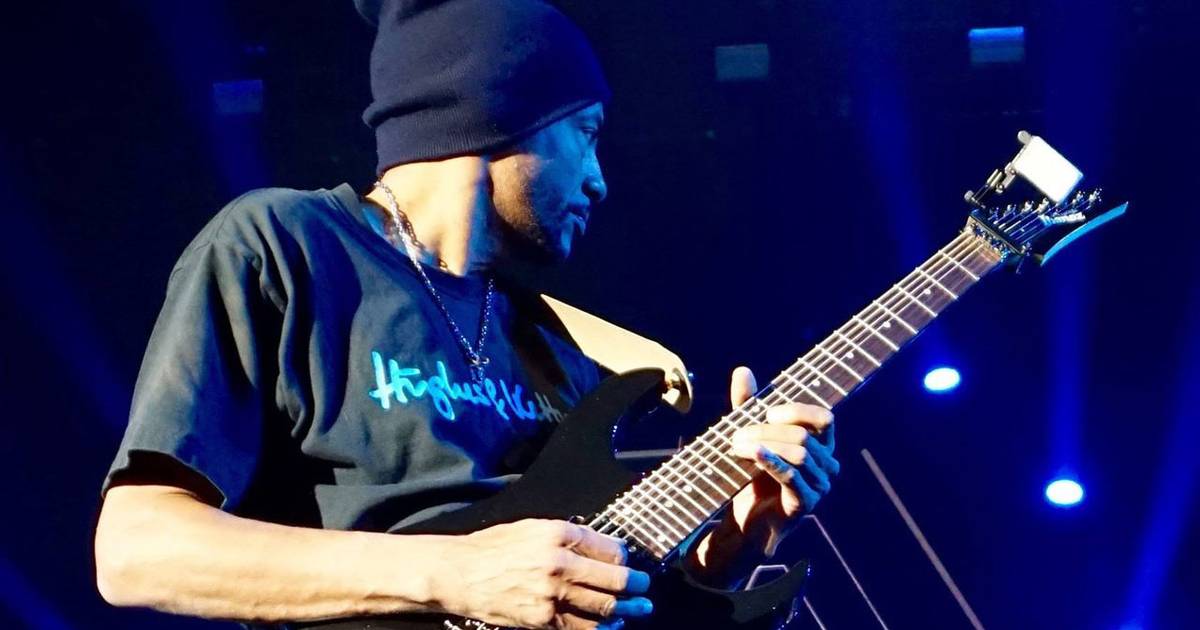
Tony MacAlpine is among the most respected instrumental rock guitarists in the world. Although he never reached the commercial popularity of Joe Satriani or Steve Vai, his influence on guitarists is enormous.
Born in 1960 in Springfield, Massachusetts, he began his musical training as a pianist. As a child, he studied classical music, and later transferred that knowledge to the electric guitar. This combination defines his style. MacAlpine does not think like a typical rock guitarist – he thinks like a composer using the guitar as a means to express complex musical ideas. Throughout his career, he has worked with Steve Vai, Billy Sheehan, Mike Portnoy, Planet X, CAB, Derek Sherinian, and many of the biggest names in virtuoso rock and progressive metal.
His style represents an exceptionally precise combination of classical music, neoclassical metal, jazz fusion, instrumental rock, and progressive metal. Unlike Yngwie Malmsteen, who emphasizes baroque virtuosity, MacAlpine uses a much richer harmony and often includes jazz ideas. His music is simultaneously intellectual and melodic.
His sound is very clean, full, modern, well-balanced, and with excellent resolution – even in extremely fast passages, every note remains distinct. Over the years, he has used various guitars, including Ibanez models and later his own Dean signature models, as well as amplifiers and processors that allow him to achieve a precise, contemporary sound. With him, there is no excessive compression or too many effects – everything serves the music.
His string bending is very precise but not as dramatic as Gary Moore's or Angus Young's – for him, it serves mainly for the smooth development of the melody, and his intonation is practically flawless. His vibrato is moderate, elegant, controlled, and always subordinated to the musical idea – he avoids excessively wide blues vibrato and prefers a more classical approach.
Legato is one of his greatest strengths – connected playing in MacAlpine's style is incredibly smooth, and the transitions between notes sound natural, without a sense of effort. In alternate picking, he reaches an exceptionally high level – even at great speed, every note is distinct, the rhythm remains stable, and the attack is consistent.
MacAlpine is among the best performers of sweep picking – his arpeggios sound smooth, even, and musical, never just for show. He uses two-handed tapping but moderately – with him, technique never overshadows the musical idea. He uses natural and artificial harmonics, but always with measure, as part of expressiveness, not just as an effect.
Although he is known mainly as a soloist, MacAlpine is an excellent rhythm guitarist – his riffs are often complex, harmonically rich, and filled with interesting rhythmic solutions. Particularly in Planet X, his ability to think as part of an ensemble is evident, rather than just as a lead instrumentalist.
Soloing and phrasing is the area where MacAlpine is among the best. His solos combine incredible technique, classical development, logical structure, and strong melodiousness – he never plays without an idea; even his fastest passages have a clear musical direction.
As an improviser, he is excellent – especially in his jazz fusion projects, he demonstrates the ability to build new musical ideas in real time without losing the logic of the composition. Here his enormous experience as a pianist is also evident.
Although he is not the author of worldwide rock hits, MacAlpine has made a huge contribution to instrumental guitar music. Albums like Edge of Insanity, Maximum Security, Freedom to Fly, and Premonition are considered classics among guitarists, and his compositions are studied as examples of the combination of technique and musicianship.
Objectively, MacAlpine has almost no technical weaknesses. The reason he is not as well-known among the general public is different – his music is complex and requires attentive listening, and does not rely on easily memorable riffs or hit choruses. For this reason, he remains a favorite primarily of musicians and connoisseurs of instrumental rock.
Tony MacAlpine is one of those musicians who never seek the spotlight but earn the unconditional respect of their peers. His playing impresses not only with technical perfection but also with musical maturity, built on a solid classical education and an extraordinary sense of harmony. He proves that virtuosity is not an end in itself – his greatest strength is the ability to turn even the most complex techniques into natural musical speech.