
 Bulgaria
  Greece
  Turkey
  Romania
  Serbia
  N. Macedonia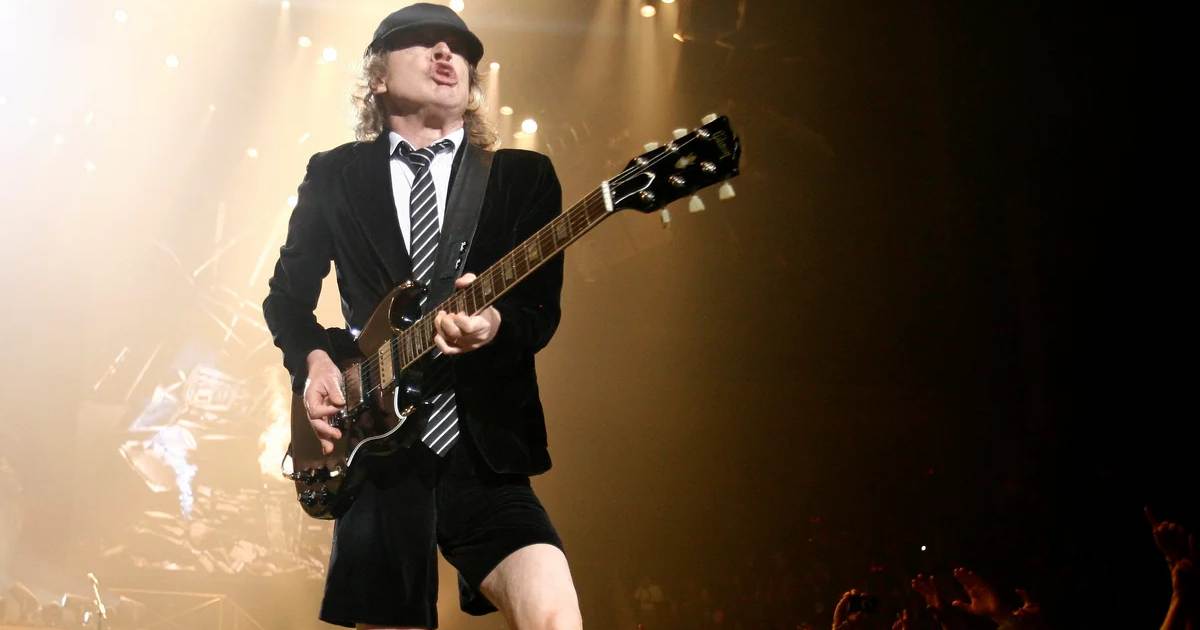
Few guitarists can be recognized with the first chord. Angus Young is one of them. As the lead guitarist and primary driving force of AC/DC, he built a style that appears simple on the surface but actually requires exceptional feel for rhythm, dynamics, and control.
In a world where many guitarists strive for increasingly complex techniques, Angus chose a different path. He remained faithful to the blues and rock and roll, proving that a few correctly played notes can be more impactful than a whole cascade of virtuosic passages. Together with his brother Malcolm Young, he created one of the most recognizable guitar sounds in the history of rock music.
His style is built on blues, rock and roll, boogie, and classic hard rock. His main strength is his incredible feel for rhythm and movement. While other guitarists often impress with complex techniques, Angus impresses with the way he makes the music 'swing.' With him, every note has energy, and every solo sounds natural and spontaneous.
His style is easy to recognize but extremely difficult to reproduce. Many guitarists can play his notes, but few can reproduce his rhythm, pick attack, and characteristic sense of time.
His sound is among the most recognizable in rock history – bright, sharp, full, dynamic, with almost no excessive distortion. Unlike many metal guitarists, Angus uses relatively moderate gain, which allows every note to remain distinct.
The main elements of his sound are the Gibson SG, Marshall amplifiers, minimal use of effects, and exceptionally strong pick attack. He is proof that great tone comes primarily from the guitarist's hands.
String bending is one of his most characteristic techniques – powerful, precise, aggressive, filled with blues feeling. He often uses whole-tone bends, sometimes more, and manages to maintain excellent intonation.
His vibrato is one of the most recognizable in rock – wide, energetic, nervous, full of life. Just one long note with his vibrato is enough to be recognized.
Perhaps his most underestimated quality is his work with the pick – strong and confident attack, excellent alternate picking, constant control over dynamics. It is the way he strikes the strings that creates much of his characteristic sound.
Despite playing hard rock, almost every one of his solos is deeply connected to the blues – the pentatonic scale, the blues scale, repetition of musical motifs, short but memorable phrases. He never plays more than necessary.
Although Malcolm Young is considered one of the greatest rhythm guitarists, Angus also has a huge contribution – the two built a guitar wall that became AC/DC's emblem. The riffs in Highway to Hell, Back in Black, Hells Bells, Thunderstruck, and Dirty Deeds Done Dirt Cheap are examples of how simple ideas can be timeless.
His solos never sound like exercises – they are continuations of the song, built from short melodic ideas, blues phrases, powerful string bends, characteristic vibrato, and excellent control over tension. Among his best solos are Let There Be Rock, Whole Lotta Rosie, Back in Black, Highway to Hell, and You Shook Me All Night Long.
Live, Angus is a very strong improviser – he often extends his solos without losing connection with the song. His live versions are full of energy and spontaneity but almost never descend into chaos.
Together with Malcolm Young, he created dozens of the greatest rock riffs. His strength is not in complex harmonies but in the ability to invent a riff that millions of people remember after the first listen – a talent that cannot be learned.
Angus never strives for the technical virtuosity of guitarists like Steve Vai, Joe Satriani, or John Petrucci, and rarely uses legato, tapping, sweep picking, or complex arpeggios. But this is a conscious choice – his philosophy is that rock music should be direct, honest, and full of energy.
Angus Young is living proof that rock music doesn't need ostentatious virtuosity to be great. On stage, he is an unstoppable force – running, jumping, spinning, playing lying on the floor, and never stopping interacting with the audience, all without affecting the quality of his performance. Few guitarists have so successfully combined musical mastery and stage presence.